Ontario spent more than two decades inspecting fire alarm systems to a standard written in 2004. On January 1, 2026, that changed for every contractor doing fire alarm inspection work in Ontario. Ontario Regulation 87/25 incorporated CAN/ULC-S536:2019 into the Ontario Fire Code, and your crews are now graded against a document that skipped the 2013 edition entirely.
Most of what has been written about this change is aimed at building owners. This is written for the people doing the work. What the mandatory forms actually demand, where crews are getting stuck on site, and why the report you hand over is only ever as good as the asset register behind it.
That last point is the whole game, and it is where a purpose-built fire platform like Uptick pulls away from a tool that just digitizes the form.
What actually changed about Ontario fire alarm inspection requirements

O. Reg. 87/25 was filed on June 4, 2025 and amended the Ontario Fire Code (O. Reg. 213/07). It adopts two standards at once: CAN/ULC-S536:2019 for inspection and testing, and CAN/ULC-S537:2019 for verification.
Five changes matter on the next annual.
- Sampling is Gone: The annual is a 100% device test. On a large building, every detector, every pull station and every notification appliance gets touched, and each one gets a result recorded against it.
- The Forms are Mandatory in Format: They used to sit in the appendix as a suggestion. In the 2019 edition they live in the body of the standard, which makes the layout itself a requirement.
- Battery Testing Needs Numbers: A load test with the measured values written on the report. A meter reading on its own no longer covers it.
- Attendance is Logged: Names, dates and times on site, recorded on the report.
- Deficiencies and recommendations are separate things: the standard defines them separately, the report keeps them apart, and each deficiency carries the clause reference it failed against.
Read those five together and a pattern shows up.
Every one of them is a documentation demand, and every one is the kind of thing paper and spreadsheets handle worst. This is the case for doing the annual on software built for fire work.
Uptick maps the S536 report to the structure of the standard and captures these fields on site as the technician works, so the record is complete when the crew leaves the building instead of getting rebuilt at a desk afterward.
What the mandatory forms demand
Field work was rarely the problem. Ontario technicians already knew how to test a panel properly. The friction is in the paperwork, and it shows up in the same few places.
1. Why a small system produces a page of N/As
This is the complaint that comes up most on small and mid-size systems, and it is worth saying plainly: N/A is a designed answer, not a failure. The form asks about features across the full range of systems the standard covers, so a small single-stage building with one panel and no voice communication will legitimately answer N/A to a lot of it.
The three answers do specific jobs. Yes means the item tested correctly. No means it did not, and that pushes the item into the deficiency section. N/A means the feature is not present or not programmed. A page of N/As on a small system is the form working as intended. What you cannot do is leave items blank or delete the rows because they looked irrelevant.
This is one place software earns its keep. In Uptick, "No Test" clears equipment that is not present in a single tap, so the technician is not hand-writing N/A down a long list or, worse, deleting rows to make the report look tidier. The unused lines are handled the way the standard wants them handled, without the busywork.
2. Can you keep your own report template
You can put your company logo on the forms. You cannot reword the items, reorder them, or trim the sections. That is the practical meaning of the forms moving into the body of the standard.
This is where a shop running a homegrown Excel sheet or a PDF it built years ago has a real gap. The field work can be flawless and the document still comes back short, because the structure is now part of what is being checked. A platform that keeps the ULC layout current takes that risk off the table. Uptick follows the section structure of the standard, so the format is right by default rather than something you have to police on every job.
3. What the attendance log requires
The log records who attended, on which dates, and for how long. On a large building spread across several visits and more than one technician, that means somebody has to keep a running record while the job is open rather than reconstructing it from memory on the Friday afternoon it gets typed up.
This is an admin that quietly disappears when the system already knows who was on site and when. In Uptick the attendance log is driven by timesheets and technician signatures pull through automatically, so the credential and attendance requirement is met without anyone rebuilding it after the fact.
4. Who is responsible for the monthly checks
Two record streams have to line up for every building. The monthly checks can be done by a person the owner designates, and that person doesn't have to be certified. The annual belongs to a certified technician. Both sets of records now sit on current forms, and an AHJ looking at the annual can reasonably ask to see the twelve monthly logs that came before it.
If your customers have been running monthly checks on a photocopied sheet from 2011, that conversation is worth having before their next annual, not after.
5. Can you inspect to the 2024 edition
ULC published a revision, CAN/ULC 536:2024, on August 5, 2024. Its headline addition is data communication link testing. Ontario's regulation names the 2019 editions, so 2019 is the baseline you are held to.
Some AHJs will accept a 2024-edition report on the basis that it covers everything 2019 asks for and more. That is their call, not your right. Confirm it with the AHJ before you rebuild your templates around the newer edition.
S536 versus S537: Which standard applies
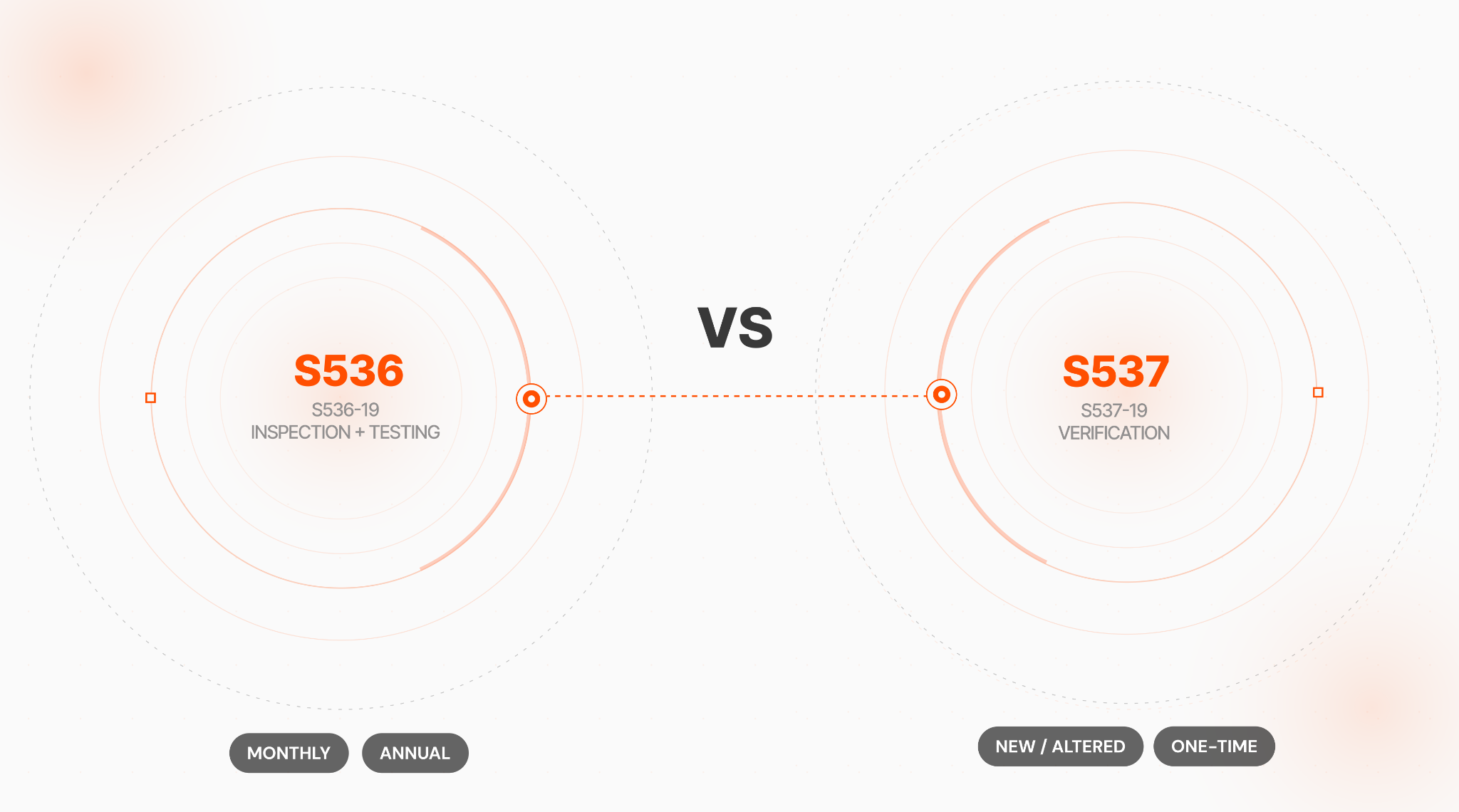
These two get used loosely on the truck, and mixing them up is a quick way to get paperwork bounced.
Verification (S537) is the one-time confirmation that a new or altered system was installed and works as designed. It happens before the system goes into service.
Inspection and testing (S536) is the recurring work that follows: the monthly checks and the annual.
O. Reg. 87/25 moved both to their 2019 editions on the same date. So if you commission or modify a system in Ontario now, the verification has to meet S537-19, and every inspection after that follows S536-19.
Where CAN/ULC-S1001 fits
One more standard gets tangled into this, and it's the one that shows up on your larger sites. CAN/ULC-S1001 covers integrated systems testing: proving the fire alarm actually drives everything wired to it, including elevator recall, HVAC shutdown, door release, and the fire pump. Ontario has required it under Building Code Sentence 3.2.10.1 since January 1, 2020, for new construction and for modifications to existing integrated systems.
Two details matter here. S1001 is run by a certified Integrated Testing Coordinator, and the same company can't do the S537 verification and the S1001 integrated test on the same building. A material change to the integrated programming also triggers a retest of the affected integrations rather than a full rerun.
What comes out of it is a cross-system sequence record, not a panel report. Different shape of document, and on a large interconnected building it has to sit alongside the S536 annuals for every system involved. Uptick holds those records against the same building and the same assets, so the sequence record, the annual, and the open deficiencies aren't spread across three inboxes.
British Columbia and Alberta already require S536-19
There is a version of this story where Ontario is out in front and the rest of the country follows. It is the wrong way round, and knowing that is useful to you.
British Columbia has required CAN/ULC-S536-19 since the BC Fire Code 2024 took effect on March 8, 2024. Alberta got there next, with the National Fire Code 2023 Alberta Edition in force on May 1, 2024, which points to fire alarm inspection and testing at CAN/ULC-S536:2019. Calgary Fire Department's own building owner guidance names the 2019 edition and asks owners to hold the current and previous annual reports against it.
That puts Ontario roughly twenty-two months behind BC and twenty behind Alberta on the same standard. Two provinces have already worked through the transition your shop is working through now, and the pattern is consistent: the field procedures were absorbed quickly, and the documentation is where the hours went.
Western contractors carry an extra layer worth knowing about if you work across provinces. Twenty-four BC jurisdictions have municipal bylaws requiring registration as an ASTTBC Registered Fire Protection Technician to inspect and test fire and life safety systems, Vancouver among them. Same standard, extra credential gate.
The National Fire Code of Canada 2020 references the 2019 editions of S524, S536 and S537, which were developed together so installation, inspection and verification line up. Provinces adopt on their own clocks. Expect the remaining ones to land in the same place. If you run work in more than one province, that spread is an argument for software that already carries the compliance forms for each jurisdiction rather than a stack of regional templates you maintain by hand. Uptick was built multi-standard from the start, which is the practical reason it travels across the Canadian provinces without a rebuild each time.
Why the asset register matters more than the form
Here is the part that decides whether year two of this is easier or harder than year one, and it is the clearest reason to look hard at how your software is built.
Say a smoke detector fails the annual in February. You quote it, the customer approves, and a technician swaps the device in March. Eleven months later somebody opens last year's report to start this year's visit.
In a form-based system, that document is a photograph of February. The March repair is not in it, because the repair happened somewhere else: a separate work order, a separate PDF, an email thread. Your technician arrives at a building and starts from data that was already wrong.
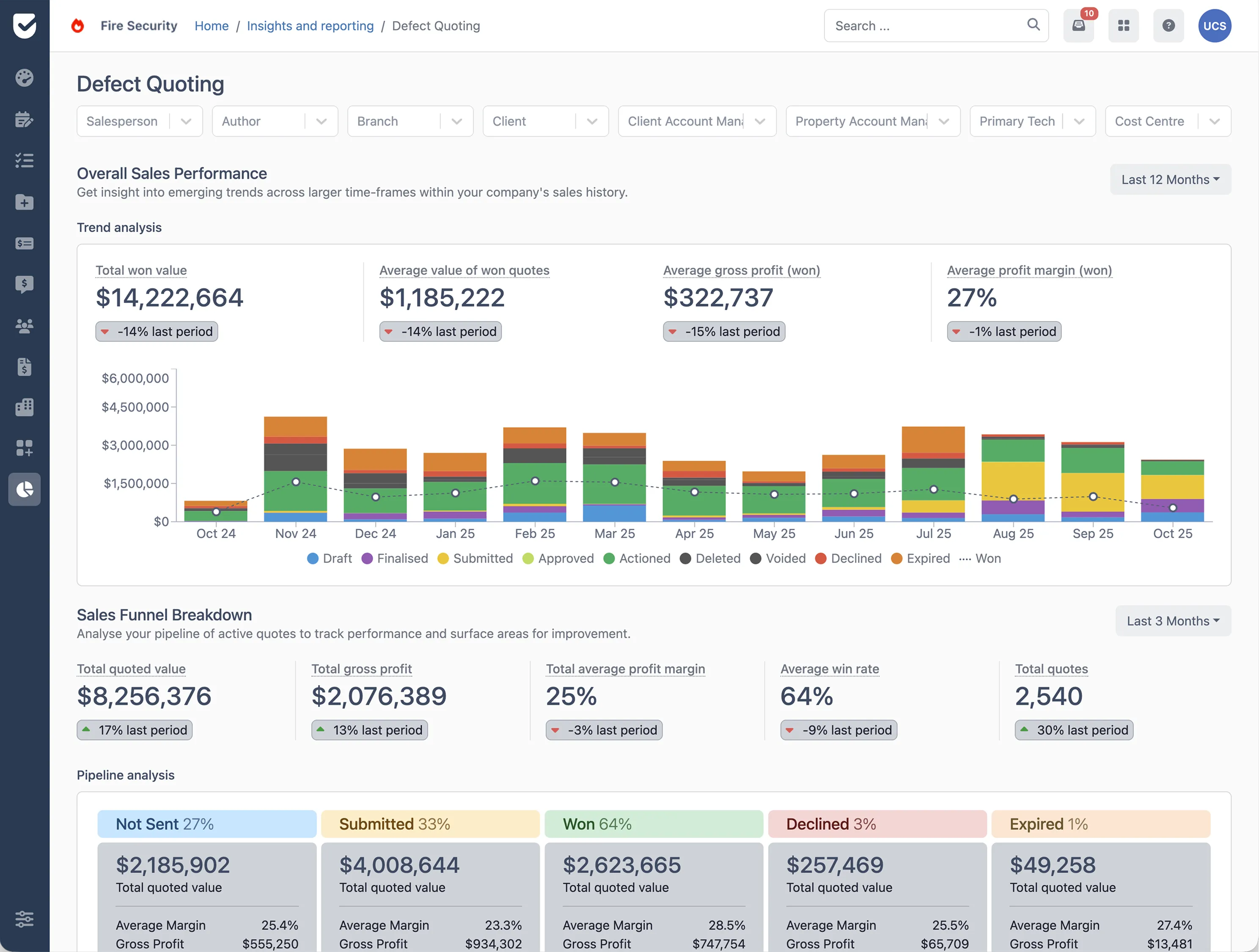
In an asset-based system the device itself was updated in March. Next year's inspection opens on current, corrected information, and nobody has to remember what happened in between. This is the difference Uptick is built around. The technician is not filling in a ULC form, they are updating the record of the actual equipment in the building, and the ULC document comes out of that record. A repair writes back to the device, so the register stays true between visits.
Multiply that across a few hundred buildings and it stops being a paperwork preference. It is the difference between adding buildings and adding admin staff.
There is also the 2019 equipment question sitting underneath this. The 2019 edition addresses CO detection tied to the fire alarm system, wireless devices and air-sampling detectors directly, where the 2004 edition largely did not.
An asset register built before 2019 may be missing devices a 2026 inspection has to account for. Worth auditing on your larger sites before the annual, rather than discovering it at the panel. A live register makes that audit a report you can pull rather than a walk-round you have to schedule.
How the annual gets finished before the crew leaves the building
Uptick works the annual from the asset register rather than the form, which is why the report is done when the van pulls away. The technician updates the record of the equipment in the building, and the ULC document comes out of that record. That is the chain a form-based tool cannot produce.
The S536 annual follows the section structure of the standard, from Section 20 through the individual device records, so inspection forms are completed as the technician works, not rebuilt afterwards. Device location and type come pre-populated from the asset register. Answers of Yes, No or N/A become the ticks and crosses on the ULC PDF, and "No Test" clears equipment that is not present in one tap.
The technician classifies a critical deficiency against a recommendation in the field, which populates the ULC deficiency table directly, so the office is not reclassifying findings later. The mandatory S536 clause reference sits on the remark itself, so a deficiency reaches the office already tied to the clause it failed, and nobody is back-filling that from the standard on a Friday afternoon. Photos taken against the device carry through into the defect quote.
Quick fixes get resolved on site. Last year's outstanding deficiency gets verified at the next annual rather than recreated. Once a repair is done, the original inspection populates with the date corrected and work order reference, and Recreate Report regenerates the ULC PDF from that job. Nobody hand-edits a PDF.
The attendance log is driven by timesheets, signatures pull through automatically, and the mobile app works offline for the basement with no signal.
Frequently asked questions
Does every device have to be tested under Ontario fire alarm inspection requirements?
Yes. The 2019 edition removed sampling. The annual is a 100% device test, and each device gets its result recorded on the individual device record.
Can we still use our own inspection report layout?
No. The forms moved out of the appendix and into the body of the standard, so the format is part of the requirement. You can apply your company logo. Rewording items, reordering sections or dropping rows is not permitted. Software that carries the current ULC layout, like Uptick, keeps the format right by default so it is not something you have to check on every job.
What counts as a battery test now?
A load test with the measured values recorded on the report. A voltage reading from a meter, or a note saying the battery is fine, does not satisfy the 2019 requirement.
Is British Columbia on the same standard as Ontario?
Yes, and it got there first. BC has required CAN/ULC-S536-19 since the BC Fire Code 2024 came into effect on March 8, 2024. Alberta followed on May 1, 2024. In Vancouver and twenty-three other BC jurisdictions, the work also has to be done by an ASTTBC Registered Fire Protection Technician.
What is the difference between S536 and S537?
S537 is verification, a one-time confirmation that a new or altered system works as designed before it goes into service. S536 is the recurring inspection and testing: the monthly checks and the annual.